Riviera Maya Yacht Charter: Planning a Private Day at Sea
Marinas, boats, weather and the questions that decide whether a charter day goes well.
In this guide
In short
Most Riviera Maya charters are priced per boat for a set block of hours and leave from Puerto Aventuras, Cancún or Cozumel. A catamaran suits families and swimming days; a motor yacht suits longer routes. Port captaincies close ports to small craft in strong wind, so confirm the weather policy, what the price excludes and whether fishing permits are included.
A private boat is the one way to see this coast without a timetable or a crowd: the reef under you, the jungle behind the beach and nobody else deciding when you leave. A Riviera Maya yacht charter is also easy to book badly, because what decides the day is rarely the boat in the photographs. It is where you leave from, the weather on the morning, what the price leaves out and who is actually running the vessel. This guide covers those decisions, in the order they matter.
How a Riviera Maya yacht charter works
Almost every charter on this coast is sold per boat, not per person, for a block of hours: a half day, a longer afternoon or a full day. The boat, the captain and the crew are yours for that time, and the route is agreed before you sail. Crew handle anchoring, lines and snorkel gear; food and drink vary widely from one operator to the next, so treat “included” as something to confirm in writing rather than assume.
Because the price is for the boat, the arithmetic changes with group size. A vessel that looks expensive for four can be the sensible choice for fourteen, and a group near a boat’s stated capacity is usually more comfortable on the next size up.
Where charters leave from
The mainland coast has little natural shelter, so departures cluster around a few harbours. Puerto Aventuras, between Playa del Carmen and Tulum, is the main one for the Riviera Maya proper: its operator describes it as the only full-service marina between Cancún and Belize, able to take boats of up to 150 feet. If you are staying anywhere from Playa del Carmen south to Tulum, it is normally the closest start; see where to stay in Playa del Carmen for how the areas relate to it.
Cancún’s hotel zone serves the north end of the coast, with the usual day running across to Isla Mujeres. Cozumel has its own boats along the island’s sheltered west coast. Crossing the channel from the mainland by private charter is possible on a full day, but for a shorter visit the public ferry is simpler; getting to Cozumel explains the options.
Choosing the boat
The real choice is between a monohull motor yacht and a catamaran, and it matters more than length. A motor yacht is fast, which is what makes the long routes practical, and a flybridge gives the best view on the water. It also rolls more at anchor and feels the afternoon chop more, particularly at the smaller end.
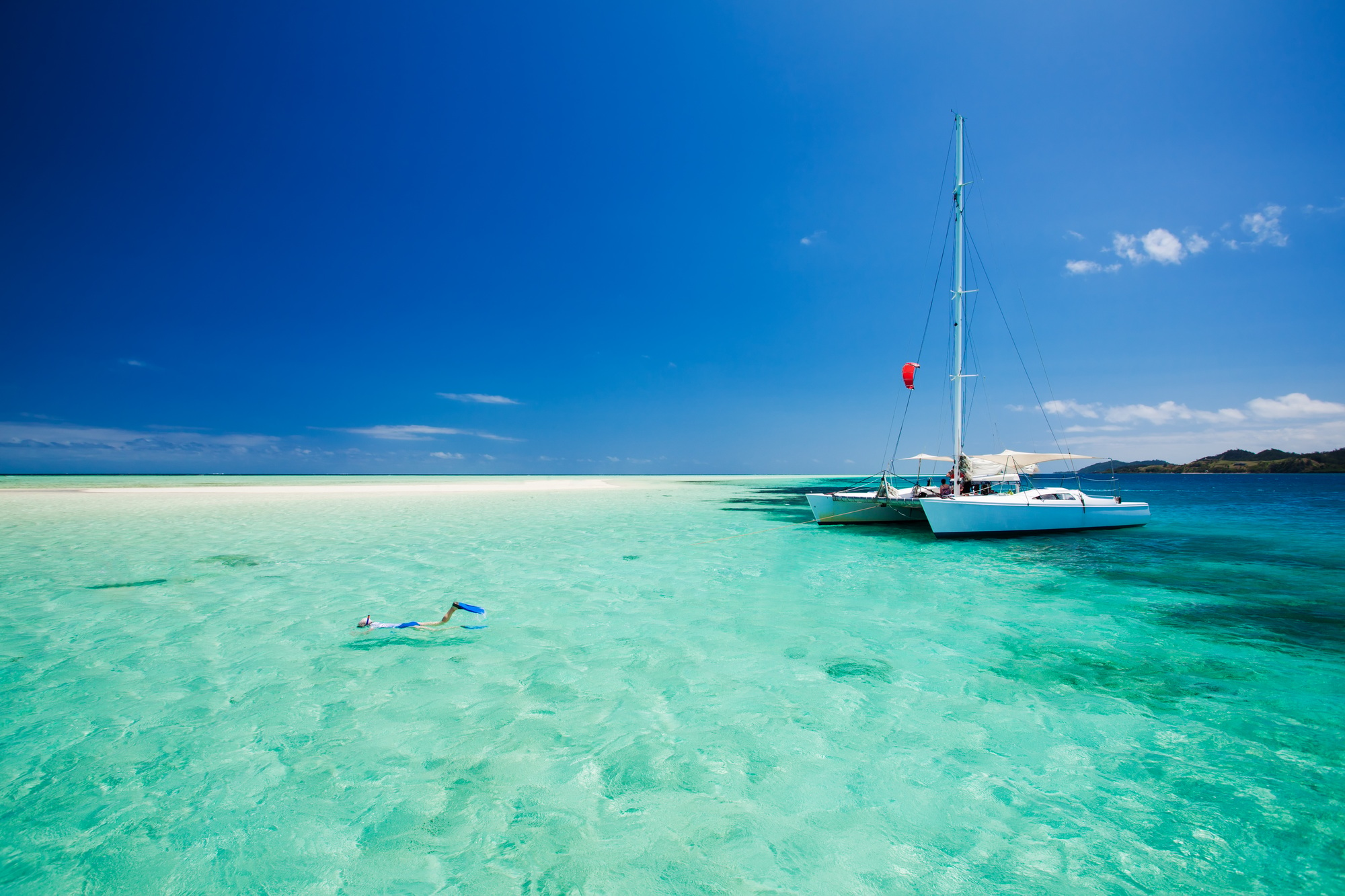
A catamaran stands on two hulls, so it sits flat under way and at anchor. It carries more deck and shade for its length, has steps into the water at the stern, and is the easier boat for children, older guests and anyone unsure about the sea. It is also slower, which keeps it to the nearer anchorages. For a day that is mostly swimming, the catamaran usually wins; for a day that is mostly travelling, the motor yacht does.
Where the day can go
- A reef anchorage. The Mesoamerican Barrier Reef runs close along this shore, and the shorter charters are built around one snorkelling stop in calm, shallow water.
- A bay or beach. Some routes anchor off a quiet bay where guests can swim ashore, a better fit for anyone who would rather stand on sand than float over coral.
- Tulum from the sea. The walled city was placed on the cliff edge to be seen from the water. A boat views it offshore and does not land there; visiting the site itself is a separate trip, covered in Tulum ruins and Parque del Jaguar.
- Cozumel’s reefs. A full day can cross to the protected reefs off the island’s southwest. They lie inside a national park with its own rules, described in diving and snorkeling in Cozumel.
Weather, port closures and seasons
On this coast the sea, not the booking, has the final word. Mexico’s port captaincies, under the Navy (SEMAR), close ports to navigation when wind and swell make it unsafe, and they publish each port’s status. Closures are usually issued by vessel size, most often to smaller craft, which covers the great majority of charter boats; larger ferries may keep running on a day when every charter stays tied up. When a port is closed, no charter leaves, whatever was paid.
Two seasons drive most closures. From roughly late autumn to early spring, cold fronts known locally as nortes can bring a day or two of strong north wind. The Atlantic hurricane season runs from 1 June to 30 November, with activity usually peaking around September. Storms come with days of warning, but a trip in those months needs flexibility. Seaweed is a separate issue that affects beaches more than open water; our sargassum guide explains how it behaves.
Mornings are usually calmer than afternoons. If the group cares about flat water and clear visibility, ask for an early start.
Fishing aboard
Many boats troll a line while under way. In Mexico, anyone fishing from a boat needs an individual sport-fishing permit from CONAPESCA, the national fisheries commission; permits are personal and come in daily, weekly, monthly and annual versions, and can be arranged online. Ask the operator whether permits for your group are included or need buying separately before anyone picks up a rod.
What to confirm before you book
- The vessel and its capacity. The named boat, its passenger limit and what happens if it is unavailable on the day.
- What the price leaves out. Marina or dock fees are often charged per guest and paid on the day; reef park fees, fishing permits, fuel for longer routes and crew gratuities vary by operator.
- Food and drink. What is aboard, and whether dietary requests, a celebration cake or a fuller menu can be added.
- The weather policy. What happens when the port captaincy closes the port: a new date, a refund, or neither.
- Transport. How you reach the marina, and how long it takes from where you are staying.
A good operator answers all five without hesitation. A Riviera Maya yacht charter that is vague on any of them is worth questioning further before you pay a deposit.